2026 Best Induction Heating Pyrolysis Plant Suppliers?

Time:2026-09-16 Author:Isabella
0%

Choosing the 2026 best Induction Heating Pyrolysis Plant suppliers requires more than comparing prices or production capacity. A reliable supplier must demonstrate stable heating, accurate temperature control, safe reactor construction, and realistic operating data. The equipment should perform consistently when processing different feedstocks, moisture levels, and particle sizes. Small details matter. Coil alignment matters. Insulation quality matters. Sensor placement matters.

Dr. Valery Rudnev, a widely recognized induction-heating specialist, has stated, “Induction heating is not simply about reaching temperature; it is about controlling where and how heat is generated.” This principle is highly relevant to modern pyrolysis systems. Uneven heating can reduce product quality, increase energy consumption, and create avoidable maintenance problems. The best suppliers should explain these risks clearly, not hide them behind impressive brochures.

This guide examines suppliers through an engineering and operational lens. It considers reactor design, electromagnetic efficiency, feedstock flexibility, emission-control systems, automation, spare-parts support, and after-sales service. Factory testing and pilot-scale evidence deserve special attention. Ask for measured energy consumption, heating curves, maintenance records, and customer references. Do not rely on attractive videos alone.

There is no perfect supplier. Some companies offer strong technology but limited local support. Others provide excellent service with less flexible equipment. That difference can become expensive. A careful buyer should compare total ownership costs, not only the purchase quotation. Safety, regulatory compliance, transparent documentation, and long-term technical support remain essential when selecting an Induction Heating Pyrolysis Plant for responsible industrial use in 2026.
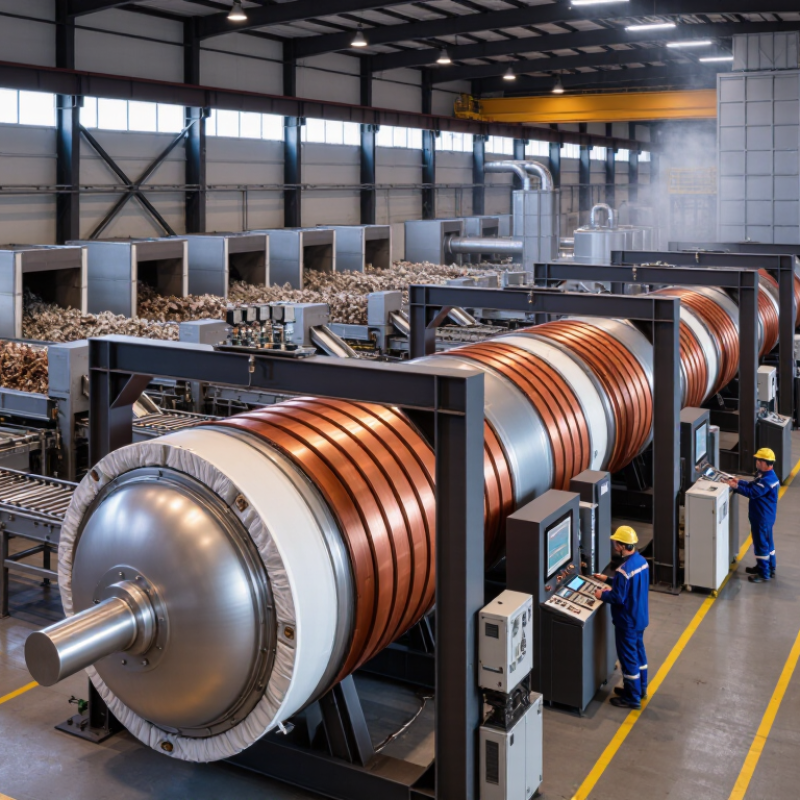
2026 Best Induction Heating Pyrolysis Plant Suppliers?

Induction Pyrolysis Fundamentals: 300–800°C Reactor Operating Range

Selecting a 2026 induction heating pyrolysis plant supplier requires more than comparing advertised output. The reactor operating range matters most. A well-designed system should maintain stable temperatures between 300 and 800°C, depending on feedstock, moisture, and target products. This range is broad.

Induction heating transfers energy through an electromagnetic field around a conductive reactor wall. Heat can rise quickly, while sensors monitor the chamber at several points. Proper insulation reduces heat loss and protects nearby equipment. However, temperature alone does not control pyrolysis quality. Residence time, particle size, oxygen exclusion, and feed preparation also influence performance. A damp feedstock may consume energy before the main reaction begins.

During supplier evaluation, request temperature uniformity data, calibration records, emergency shutdown logic, and commissioning procedures. Ask how the control system responds when feed rates change. Reliable suppliers should explain coil design, refractory service life, cooling requirements, and emission treatment without hiding behind vague efficiency claims. Independent testing is valuable.

The 300–800°C range should be treated as an engineering window, not a guaranteed result. Some materials react below 500°C, while others require higher settings and longer residence times. Real operation can be less perfect than laboratory trials. A careful supplier acknowledges this uncertainty and supports controlled testing, maintenance training, and documented process adjustments.

Supplier Evaluation Metrics: 85–95% Heating Efficiency and Feedstock Yield

2026 Best Induction Heating Pyrolysis Plant Suppliers?

In 2026, supplier evaluation should begin with measurable performance, not attractive brochures. The useful benchmark is 85–95% heating efficiency under clearly defined operating conditions. A credible supplier should explain whether this figure includes electricity, cooling, gas treatment, and standby losses. Ask for test reports, energy-meter records, and feedstock details. Numbers need context.

Heating efficiency should remain stable during startup, continuous operation, and shutdown. During site visits, inspect temperature sensors, insulation, coil placement, and control responses. One practical test compares electricity consumed with heat transferred into the reactor. If the chamber needs frequent reheating, the quoted efficiency may be optimistic. That gap matters.

Feedstock yield must be measured through a complete mass balance. Moisture content, particle size, residence time, and reactor temperature can change results significantly. Request independent analysis of solid, liquid, and gas outputs from representative feedstock. A supplier claiming high yield without laboratory data deserves careful questioning. I would also examine the worst test result, not only the best one. Real feedstock is inconsistent, and perfect results rarely survive daily operation. Safety records, maintenance access, operator training, and transparent warranty terms add further confidence. A dependable supplier welcomes verification before purchase.

2026 Best Induction Heating Pyrolysis Plant Suppliers? - Supplier Evaluation Metrics: 85–95% Heating Efficiency and Feedstock Yield

Evaluation Dimension Recommended Benchmark Acceptable Screening Range Verification Method Evaluation Significance
Overall heating efficiency 85–95% At least 80% Independent heat-balance test using measured electrical input and useful heat delivered to the reactor Indicates how efficiently supplied energy is transferred to the feedstock rather than lost to the surroundings.
Electrical-to-thermal conversion efficiency 90–97% 85–98% Review power-quality records, real-time kWh data, and thermal output measurements Separates induction-system performance from insulation, exhaust, and process losses.
Feedstock liquid-product yield 35–60 wt% for suitable plastics or rubber feedstocks 20–65 wt%, depending on feedstock composition Feedstock-specific mass balance from a controlled pilot test; report wet and dry basis separately Yield varies substantially with moisture, ash, polymer type, contamination, temperature, and residence time.
Non-condensable gas yield 10–30 wt% 5–40 wt% Gas flow measurement combined with laboratory composition analysis and complete mass closure A stable gas stream can support process heating, but composition and emissions controls must be assessed.
Solid char or residue yield 5–35 wt% 3–50 wt% Weigh recovered solids and report fixed carbon, ash, moisture, and contaminant content High ash or inorganic contamination can reduce product value and increase disposal requirements.
Temperature operating range 350–700 °C for common slow-to-intermediate pyrolysis applications 300–800 °C, subject to feedstock and product objectives Calibrated temperature sensors at multiple reactor locations, with recorded process trends Temperature affects cracking severity, vapor composition, liquid yield, gas yield, and char properties.
Temperature uniformity Within ±10–15 °C across the active reaction zone Within ±20 °C Multi-point temperature mapping at steady state under representative feed rates Uniform heating helps prevent under-processing, excessive cracking, and inconsistent product quality.
Specific electricity consumption Approximately 80–180 kWh per tonne of feedstock, excluding upstream preparation 60–250 kWh/t, depending on moisture and operating temperature Measure electricity at the plant boundary during a continuous production run Provides a comparable basis for operating-cost estimates; drying and shredding loads must be reported separately.
Feedstock moisture tolerance Preferably below 10 wt% for stable thermal operation Up to 15–20 wt% with adequate pre-drying Moisture analysis before feeding and comparison of energy use at different moisture levels Water consumes heat for evaporation and can lower throughput and condensable-product yield.
Continuous operating availability At least 90% scheduled availability after commissioning 85–95% Review a minimum 30-day operating log including planned and unplanned downtime Availability often has a greater effect on annual output than rated hourly capacity.
Mass-balance closure 95–105% of measured feedstock mass 90–110% Independent weighing of feedstock, liquid, gas, char, wastewater, and collected fines A closed balance is essential for credible yield claims and financial modelling.
Emission-control capability Integrated gas cleaning, pressure control, flare or thermal oxidizer, and monitoring provisions System-specific; must meet local regulatory limits Review permits, process-flow diagrams, sampling results, and applicable air-quality standards Pyrolysis gas and vapors may contain carbon monoxide, hydrocarbons, particulates, and other regulated pollutants.
Safety and control features Automated interlocks, oxygen monitoring, pressure relief, emergency shutdown, and inert-gas capability where required Mandatory before commercial operation Functional safety review, hazard analysis, control-system demonstration, and inspection records Pyrolysis vapors and gases are combustible; oxygen ingress and pressure excursions require engineered safeguards.
Supplier performance evidence Feedstock-specific pilot data plus a guaranteed acceptance test Laboratory data only should be treated as preliminary Require signed test protocols, raw data, sampling procedures, and clearly defined guarantee conditions Supplier claims are comparable only when feedstock, moisture, throughput, temperature, and measurement boundaries are identical.

Note: The ranges above are screening benchmarks rather than guaranteed plant performance. Actual heating efficiency and product yields must be confirmed through a feedstock-specific, independently witnessed mass-and-energy-balance test.

2026 Capacity Comparison: Modular Plants Processing 1–20 Tonnes Daily

Choosing an induction heating pyrolysis plant supplier requires more than comparing brochure capacity. The practical question is whether a modular system can process one to twenty tonnes daily with stable output. Small 1–3 tonne units suit pilot operations and limited feedstock supplies. Five-tonne systems offer a useful middle ground. They need less infrastructure than larger installations. Ten-tonne plants require stronger power distribution, feed preparation, and continuous monitoring. At 20 tonnes daily, storage, heat recovery, and maintenance planning become critical.

Induction heating can provide responsive temperature control when the reactor uses a suitable conductive susceptor. It does not automatically solve uneven heating. Feedstock moisture, particle size, and contamination still affect performance. A reliable supplier should provide measured data, not only rated throughput. Ask for residence time, energy consumption, start-up duration, product testing, and gas-cleaning performance. Request references from comparable installations.

A capacity table can mislead.

Experienced buyers should inspect the complete process boundary. This includes shredding, feeding, condensation, gas treatment, residue handling, and emergency shutdown systems. Modular expansion may appear economical, but duplicated controls and utilities can raise operating costs. I would also question optimistic claims based on ideal feedstock. Real facilities face wet material, changing composition, and occasional downtime. Independent testing, documented maintenance procedures, operator training, and local compliance support make supplier comparisons more dependable. A smaller plant with transparent data may outperform a larger unit that lacks process discipline.

2026 Modular Induction Heating Pyrolysis Plant Capacity Comparison

Typical modular configurations processing 1–20 tonnes of feedstock per day

The chart compares common nominal capacity classes for modular pyrolysis plants. Annual throughput is calculated using 330 operating days per year and excludes downtime, maintenance, and feedstock preparation losses. Actual output depends on feedstock type, moisture content, operating schedule, and reactor design.

Safety Standards: IEC 60519, ISO 9001, and Emission-Control Systems

Selecting the best induction heating pyrolysis plant supplier in 2026 requires more than comparing heating capacity or quoted prices. UNEP’s 2024 Global Waste Management Outlook estimates that municipal waste could reach 3.8 billion tonnes annually by 2050. This pressure makes controlled thermal processing increasingly important. Suppliers should show how their equipment follows IEC 60519 safety principles, including electrical protection, grounding, temperature control, and emergency shutdowns. Ask for test records, not polished claims.

ISO 9001 certification can indicate disciplined quality procedures, but it does not prove reliable plant performance. The ISO Survey 2023 recorded more than 1.2 million ISO 9001 certificates worldwide, showing its broad adoption. It still requires careful verification. Check calibration logs, operator training, maintenance records, and documented corrective actions. Small details matter.

Emission control needs equal attention. A credible supplier should provide continuous monitoring for particulate matter, carbon monoxide, volatile organic compounds, and acid gases. Gas-tight feeding, secondary treatment, filtration, and safe residue handling should appear in the design documents. The International Energy Agency repeatedly identifies efficiency and monitoring as practical routes for reducing industrial energy waste. Yet induction systems are not automatically clean. Electricity sources, feedstock moisture, operating temperature, and maintenance can change results. Some supplier data may look incomplete. That is a warning, not a minor inconvenience.

Selecting a Supplier: ASTM D86 Testing, Warranty Terms, and Total Cost

Choosing a 2026 induction heating pyrolysis plant supplier requires more than comparing purchase prices. Request recent ASTM D86 test results for the liquid output. These results show boiling ranges and help assess product consistency. Ask whether an independent, accredited laboratory performed the testing. A supplier should also explain sampling methods, operating temperatures, and feedstock conditions. Without this information, a polished report may reveal little.

Warranty terms need careful reading. Confirm coverage for the reactor, induction system, sensors, control cabinet, and major seals. Check response times, replacement procedures, exclusions, and required maintenance records. A two-year warranty sounds attractive, but limited coverage can create serious costs. Ask whether installation errors, unstable power, or unsuitable feedstock void protection. Keep every promise in the contract. Verbal assurances are difficult to measure later. I would also inspect weld quality, insulation, emergency controls, and service documentation before signing. A remote video tour helps, but it cannot replace an on-site inspection.

Tips: Build a total-cost worksheet before negotiations. Include shipping, installation, electrical upgrades, labor, training, laboratory testing, emissions controls, spare parts, and downtime. Calculate energy use per operating hour, not only the rated capacity. Request references from similar installations and ask about actual maintenance delays. A cheaper unit may consume more power or need frequent sensor replacement. This is easy to underestimate. I have found that realistic operating data is often less impressive than sales projections, but it is far more useful for planning.

FAQS

What reactor temperature range is suitable for induction pyrolysis?

A practical engineering window is 300–800°C. The correct setting depends on feedstock, moisture, particle size, and residence time. This range is not a guaranteed operating result.

How does induction heating transfer energy?

An electromagnetic field heats the conductive reactor wall. Heat can rise quickly. Multiple sensors should monitor different chamber areas. Good insulation limits heat loss near surrounding equipment.

Does temperature alone determine pyrolysis quality?

No. Oxygen exclusion, feed preparation, particle size, and residence time also matter. Damp material may consume energy before the main reaction starts. That detail is easy to underestimate.

What information should buyers request from a supplier?

Request temperature uniformity data, calibration records, and emergency shutdown logic. Also ask for commissioning procedures and responses to changing feed rates. Vague efficiency claims are not enough.

What safety features should the system include?

The design should address electrical protection, grounding, temperature control, and emergency shutdowns. Ask for test records. Do not rely only on attractive brochures.

Does quality certification prove reliable plant performance?

No. A certification may show organized quality procedures. It does not prove stable output, durable components, or successful commissioning. Check calibration logs, training records, maintenance history, and corrective actions.

Which emission controls deserve careful review?

Review gas-tight feeding, secondary treatment, filtration, and safe residue handling. Monitoring should include particles, carbon monoxide, volatile organic compounds, and acid gases. Induction heating is not automatically clean.

How can real operation differ from laboratory testing?

Commercial operation faces changing moisture, feed rates, maintenance needs, and residence times. Some materials may need higher temperatures or longer processing. Laboratory results can look cleaner than reality. That deserves honest testing.

What should a careful supplier provide after installation?

The supplier should support controlled testing, operator training, maintenance guidance, and documented adjustments. Cooling needs, coil design, refractory life, and monitoring methods should be explained clearly. Some uncertainty remains. That is normal, but hiding it is not.

Conclusion

Choosing the best Induction Heating Pyrolysis Plant in 2026 requires careful evaluation of engineering performance, safety, capacity, and long-term operating costs. Effective systems should maintain a stable reactor temperature between 300 and 800°C while delivering approximately 85–95% heating efficiency and consistent feedstock yields. Modular configurations are especially valuable, offering processing capacities from 1 to 20 tonnes per day and allowing facilities to expand as demand grows.

Supplier selection should also focus on compliance with IEC 60519, quality-management practices aligned with ISO 9001, and reliable emission-control systems. Independent ASTM D86 testing can help verify product characteristics and process consistency. Buyers should compare warranty coverage, technical support, maintenance requirements, energy consumption, installation costs, and total cost of ownership rather than relying only on the initial purchase price. A transparent supplier with documented testing, clear performance specifications, and strong safety procedures can provide a more dependable investment for responsible industrial applications.


Isabella

Isabella

Isabella is a dedicated marketing professional with a sharp focus on driving brand growth and engagement through strategic content creation. With an extensive background in digital marketing, she combines her passion for storytelling with her keen understanding of industry trends to deliver......