A Continuous Tyre Pyrolysis Plant is an industrial system designed to process prepared end-of-life tyres through a steady, controlled thermal cycle. Unlike batch equipment, it aims to feed material and discharge outputs without stopping for every load. The tyres are heated in a low-oxygen environment, producing vapours that can be cooled into an oil-like liquid, alongside non-condensable gas, recovered steel, and carbon-rich solid residue. The exact product mix depends on feed preparation, temperature control, residence time, and equipment design. Details matter.
To understand how the plant works, it helps to follow the material path: tyre preparation, sealed feeding, reactor heating, vapour handling, condensation, and residue removal. Each stage needs monitoring. A continuous line may support consistent processing, but it depends on stable feed size, effective seals, temperature readings, and planned maintenance. Small leaks or uneven material flow can affect operation, so output and efficiency claims should be checked against documented operating data, not assumed from a brochure. Not magic. The term “pyrolysis” also does not guarantee that every resulting fraction is ready for sale or reuse; testing and suitable handling remain important. Environmental performance depends on the complete installation, including gas treatment, emissions monitoring, and responsible residue management. These systems are technically interesting, but their practical value is easier to judge when operators disclose limitations as well as benefits. That part is sometimes missing—and deserves closer attention.
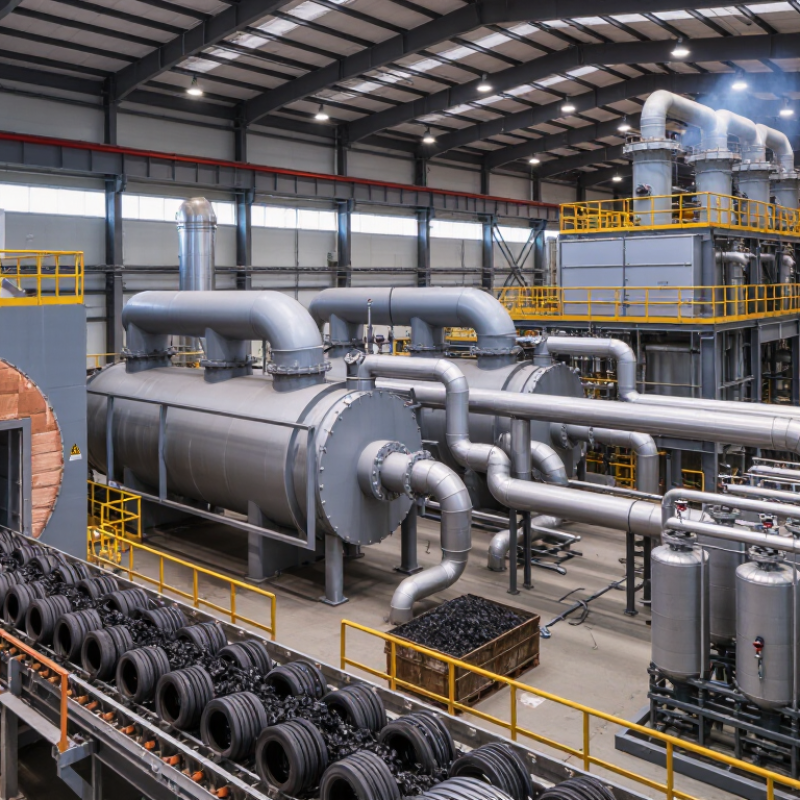
A continuous tyre pyrolysis plant converts prepared end-of-life tyres into vapours, solid char, steel, and process gas inside an oxygen-limited reactor. “Continuous” means material moves through the system during operation, rather than being loaded and unloaded in separate batches. Feed size and cleanliness matter. Loose steel or inconsistent chips can disrupt feeding and heat transfer.
Core components begin with a controlled feed hopper and sealed conveyor or airlock. A rotating or moving-bed reactor heats the tyre material at a managed temperature. Vapours then pass through pipes and condensers, where liquid fractions are collected. Non-condensable gas may be routed back as process fuel, while char and recovered steel leave through enclosed discharge equipment. Sensors, pressure controls, and exhaust-treatment equipment support stable operation. Small details count.
The scale of the waste stream is substantial. ETRMA’s End-of-Life Tyre Management Report 2021 estimates that Europe generated about 3.9 million tonnes of end-of-life tyres, with roughly 95% collected and treated. That figure describes the regional waste system, not guaranteed feedstock for any individual plant. A limitation deserves attention: continuous equipment still needs reliable sorting, steady feeding, and careful monitoring. A “continuous” label alone says little about uptime or product quality.
A continuous tyre pyrolysis plant depends on steady, well-prepared feedstock. Incoming tyres are checked for oversized debris, mud, and items that could obstruct conveyors. Preparation varies by reactor design. Some systems accept whole tyres, while others require cut or shredded pieces.
Size matters. Tyres may be cut into sections so they move consistently through the feed system. If steel belts remain, equipment must be designed to handle them; some processes separate metal earlier. Operators should follow the plant’s specifications rather than assume every tyre needs identical treatment. That detail is easy to overlook.
Prepared material travels by conveyor or another metered feeder toward the reactor inlet. Sealed feeding equipment helps limit unwanted air entry, while sensors and operating checks support a controlled, continuous flow. Feed that arrives unevenly can interrupt production. Simple in theory. Less simple in practice. Tyres vary in size, wear, and construction, so the feed rate may need adjustment. Careful inspection and a clear record of material conditions help operators make those adjustments responsibly.
A continuous tyre pyrolysis plant feeds prepared tyre pieces into a heated reactor at a steady rate. The system limits oxygen, allowing the rubber to break down through heat rather than open burning. Before feeding, operators typically remove or manage oversized material and check that the feed moves evenly. A sealed feeder helps limit air entering the reactor. That small detail matters.
Inside the reactor, heat breaks the tyre material into vapors, gas, and solid residue. Temperature and residence time affect the output, so sensors and process controls are important. Conditions vary between plant designs and feedstock. Real tyres are not perfectly uniform, which can make a steady process less tidy than it sounds on paper.
The vapors pass through cooling equipment, where some condense into liquid products. Remaining non-condensable gas may be used as process fuel, depending on the system and its controls. Solid residue is cooled before further handling; steel can then be separated, while the carbon-rich material may need additional treatment for a defined use. Not quite simple. Operators also monitor pressure, temperatures, and gas-cleaning equipment throughout the run. If readings drift, they need to investigate rather than assume the plant is operating normally.
A continuous tyre pyrolysis plant heats shredded end-of-life tyres in a low-oxygen reactor. Its main outputs are pyrolysis oil, recovered carbon black, steel, and non-condensable gas. Product yields vary with tyre composition, operating conditions, and separation equipment, so fixed yield claims deserve scrutiny. The U.S. Tire Manufacturers Association’s 2019 Scrap Tire Management Report estimated that the United States generated 266 million scrap tyres in 2017; about 76% entered end-use markets. This figure shows the scale of tyre recovery, not guaranteed demand for pyrolysis products.
Pyrolysis oil may be used as industrial fuel or as feedstock after testing and suitable upgrading. Its sulfur, water, and chemical composition affect its value. Recovered carbon black can be used in rubber compounds, plastics, or pigments, but buyers check consistency and contaminants. Recovered steel goes to metal recyclers for remelting into new steel products. Non-condensable gas may supply heat to the process, although start-up and operating conditions still require energy. These outputs are useful. They are not interchangeable. Operators should confirm specifications with buyers; a dark, oily sample alone says little about performance. Scrap-tyre market reports track broad reuse categories, but do not show that every plant achieves the same product quality or sales.
A continuous tyre pyrolysis plant heats prepared rubber in an oxygen-limited reactor and separates vapours, gas, and solid char. Its continuous feed can stabilize output, but it also makes steady monitoring essential. Seals, feed locks, and condensers need routine inspection; a small leak can release combustible gas or odorous vapours. Small leaks matter. Operators should track reactor pressure and temperature, check gas detection points, and investigate unusual readings rather than relying only on scheduled maintenance.
Emission control should follow the whole process, not just the stack. Enclosed transfer points, effective vapour capture, condensers, and suitable gas treatment help limit dust, volatile compounds, and combustion pollutants. Stack testing and leak checks can reveal problems that visual inspections miss. The European Tyre and Rubber Manufacturers’ Association reported that Europe generated about 3.55 million tonnes of end-of-life tyres in 2019, with roughly 95% entering recovery routes. That scale illustrates why consistent handling and documented operating data matter. The figure describes tyre recovery, not pyrolysis emissions; no single emissions result should be assumed for every plant. A useful operating record includes feed rate, energy use, downtime, maintenance findings, and monitoring results. These records also expose a difficult truth: a process can appear stable while controls quietly degrade. Operators should review trends and correct faults promptly.
| Dimension | Typical Process or Condition | Key Controls and Checks | Operational Consideration |
|---|---|---|---|
| Process overview | A continuous plant feeds prepared end-of-life tyres into a heated reactor, where thermal decomposition occurs with little or no oxygen. Products commonly include solid char, condensable vapours that form oil, and non-condensable gas. | Monitor feed rate, reactor temperature, pressure, and product-handling systems using site-specific operating procedures. | Actual product yields and composition vary with tyre composition, feed preparation, reactor design, and operating conditions. |
| Feed preparation | Tyres may be inspected and cut or shredded before feeding. Steel and textile components may be separated before or after processing, depending on the plant design. | Check feed size and consistency; remove unsuitable materials; use guarded equipment and isolation procedures for maintenance. | Foreign objects and inconsistent feed can interrupt conveying, damage equipment, or affect stable operation. |
| Continuous feeding and discharge | Sealed feeders and discharge arrangements are commonly used to move solids while limiting air entry and process-gas leakage. | Inspect seals, drives, interlocks, and transfer points. Verify that equipment operates within its design pressure and temperature limits. | Feeder or seal problems can introduce oxygen, release hot gases, or disrupt reactor pressure control. |
| Oxygen exclusion | Pyrolysis is an oxygen-limited thermal process, not open burning. Air ingress can create fire, explosion, or product-quality hazards. | Use appropriate sealing, pressure control, gas monitoring, and documented startup, shutdown, and upset-response procedures. | Safeguards and alarm limits should be determined by engineering assessment and applicable codes, not assumed to be identical at every site. |
| Process-gas management | Non-condensable gas may be treated and used as process fuel, or managed through another permitted system. Excess or off-specification gas may require a designed disposal route. | Provide suitable gas isolation and treatment equipment; monitor for leaks and confirm that any combustion or disposal equipment is operating as designed. | Gas composition and flow can change with feed and operating conditions. The plant needs a safe response for startup, shutdown, and process upsets. |
| Vapour condensation | Process vapours are typically cooled in condensation equipment to recover liquid products. Uncondensed gas continues to downstream handling. | Maintain condensers and pipework; check temperatures, pressure, leakage, and the condition of collected liquids. | Condensable vapours and liquids may be hot or flammable. Storage and transfer systems require suitable containment and fire protection. |
| Air emissions | Potential emission sources can include combustion exhaust, fugitive process-gas leaks, dust from solids handling, and emissions during abnormal operation. | Identify sources through an emissions inventory. Use applicable capture, treatment, combustion, filtration, or monitoring systems specified by the permit and design. | Required pollutants, monitoring methods, and emission limits depend on local regulations, permit conditions, and the plant’s actual equipment. |
| Dust and particulate control | Shredding, conveying, char handling, and storage can generate dust; fine particles may require particular attention during transfer and cleanup. | Use enclosed handling or local extraction where appropriate, maintain dust-control equipment, and follow safe housekeeping practices. | Assess combustible-dust hazards where relevant. Avoid cleaning methods that disperse dust into the air. |
| Fire and explosion safety | Flammable gases and liquids, hot surfaces, and possible air ingress make fire and explosion hazards important design and operating considerations. | Conduct a site-specific hazard assessment. Provide suitable detection, isolation, emergency shutdown, ventilation, and fire-protection measures as required by the design and regulations. | Emergency arrangements should address leaks, loss of utilities, abnormal pressure, fire, and safe evacuation. |
| Pressure and temperature protection | Reactors, piping, and associated equipment operate under defined temperature and pressure conditions; the exact conditions depend on the plant design. | Use appropriately selected instruments, alarms, interlocks, and pressure-relief provisions. Inspect and maintain them according to the equipment design and applicable requirements. | Never rely on a single instrument or bypass a protective device without an authorized, controlled procedure. |
| Worker health and safety | Workers may encounter heat, noise, moving machinery, process gases, dust, and hot solids or liquids. | Apply task-based risk assessments, machine guarding, training, exposure controls, safe access, and appropriate personal protective equipment. | Personal protective equipment complements, but does not replace, effective engineering and administrative controls. |
| Start-up, shutdown, and maintenance | Changes in temperature, gas flow, and equipment status make transitions and maintenance important operating phases. | Use written procedures, defined authorization, equipment isolation, and verification before maintenance or entry into hazardous areas. | Maintenance should account for residual heat, stored pressure, flammable material, and hazardous energy. |
| Solid products and residues | Recovered char and separated metal require controlled cooling, handling, storage, and characterization before further use or disposal. | Prevent dust release and uncontrolled contact with hot material; assess product quality and applicable waste or product requirements. | Whether a recovered material can be sold, reused, or must be managed as waste depends on its properties and local rules. |
| Environmental compliance | Permits may address air emissions, wastewater, noise, waste, storage, and reporting, depending on the jurisdiction and facility. | Maintain permit records, inspection and monitoring results, operating logs, and corrective-action documentation. | Regulatory requirements should be confirmed with the relevant authorities before construction and operation. |
| Note: This table describes general considerations for continuous tyre pyrolysis plants. Equipment configuration, operating limits, emissions controls, and legal requirements vary by facility and jurisdiction; site-specific engineering and regulatory review are necessary. | |||
No. Some reactors accept whole tyres, while others need cut or shredded pieces. Follow the plant’s specifications.
Mud, oversized debris, and uneven tyre sizes can obstruct conveyors or disrupt feeding. A quick check helps. It does not catch everything.
A conveyor or metered feeder moves prepared tyres toward the reactor. Sealed feeding equipment helps limit unwanted air entry. Uneven material may still interrupt the flow.
The main outputs are pyrolysis oil, recovered carbon black, steel, and non-condensable gas. Their quantities and quality vary.
It may serve as industrial fuel or feedstock after testing and suitable upgrading. Sulfur, water, and chemical composition affect its value.
Not automatically. Rubber, plastics, and pigments may use it, but buyers check consistency and contaminants. A dark sample proves little.
Track reactor temperature, pressure, feed rate, energy use, and downtime. Check seals, feed locks, condensers, and gas detection points. Small leaks matter.
Enclosed transfer points, vapour capture, condensers, and suitable gas treatment can help. Stack testing and leak checks may reveal faults that visual inspections miss.
Records help operators spot changes in maintenance findings, monitoring results, and energy use. A process may seem stable while controls quietly degrade. Dig deeper.
A Continuous Tyre Pyrolysis Plant is an industrial system designed to process end-of-life tyres in a steady, controlled sequence. Before processing, tyres are inspected and prepared by removing unsuitable material and, where required, reducing their size. A feeding system then transfers the prepared tyres into a sealed reactor, where heat breaks down the rubber in a low-oxygen environment.
The process typically includes controlled heating, vapour collection and condensation, and separation of the resulting materials. Outputs may include recovered oil, combustible gas, solid carbon-rich material, and steel, each of which can have appropriate industrial uses after further treatment. Reliable operation depends on monitoring temperature, pressure, and material flow. Sealed equipment, gas handling systems, emission treatment, fire prevention measures, and regular maintenance help support safe operation and reduce environmental impacts.
Huayuan