The global industrial landscape is witnessing a paradigm shift. As the world moves toward a Circular Economy, the demand for sophisticated rubber recycling machine factories has reached an all-time high. Every year, billions of waste tires are generated globally, posing a significant environmental challenge if not processed correctly. Traditional landfilling is no longer a viable or legal option in most developed nations.
Today, "Waste-to-Energy" (WtE) and "Waste-to-Resource" are not just slogans but multi-billion dollar industries. High-quality rubber recycling machines utilize thermochemical decomposition (pyrolysis) to transform end-of-life tires into valuable commodities: Fuel Oil, Carbon Black, Steel Wire, and Combustible Gas. This industrial evolution is driven by stringent ESG (Environmental, Social, and Governance) mandates and the urgent need for sustainable raw materials.
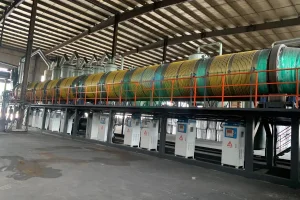
Modern factories are transitioning from batch processing to fully continuous pyrolysis systems. This eliminates manual feeding, reduces labor costs by 60%, and ensures a stable, high-purity output.
Artificial Intelligence is now integrated into the control centers. Sensors monitor pressure, temperature, and emission levels in real-time, providing predictive maintenance alerts and optimizing energy consumption.
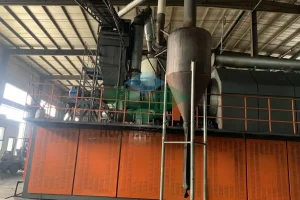
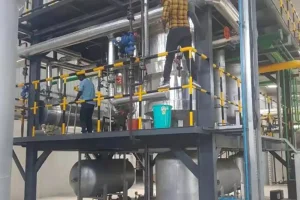
The latest generation of recycling machines features advanced de-dusting systems (activated carbon, water spray, ceramic ring adsorption) that exceed European Union and North American environmental standards.
Global enterprises, from cement plants in Southeast Asia to energy conglomerates in Europe, seek Rubber Recycling Machine Factories that can deliver more than just hardware. The core requirements include:
Southeast Asia: High-capacity batch plants for massive tire waste stockpiles.
European Union: Continuous pyrolysis systems with ultra-low emission scrubbers and carbon black deep-processing units.
Middle East: Heat-integrated systems that utilize waste gas to power the entire distillation process.
Focusing on waste to energy and waste tire pyrolysis technology, Huayuan Tech is not just a manufacturer; we are industry pioneers. Founded in 1968, we have spent over half a century perfecting thermal equipment and pressure vessel engineering.
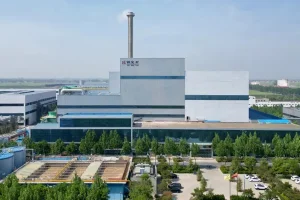
Our company covers a total area of 209,335 square meters, with a dedicated plant area of 98,680 square meters. This scale allows us to handle multiple large-scale global orders simultaneously.
With more than 500 employees, our engineering and technical personnel account for 34% of our workforce, ensuring every recycling machine is designed with mathematical precision.
Holding National A-class boiler and A2-class pressure vessel manufacturing licenses, we are also certified by ASME (USA) and ISO9001, ISO14001, and OHSAS18001.
As a leading Chinese factory, we offer a unique competitive advantage: The perfect synergy of cost-efficiency and high-end engineering. By leveraging China's robust industrial supply chain and our proprietary R&D, we deliver rubber recycling plants that outperform European counterparts in ROI while meeting the same rigorous safety standards.
With the continuous development of enterprises, Huayuan has now become a conglomerate engaged in boiler manufacturing, pressure vessel design, waste tire and plastic scrap pyrolysis machine development, sales, consulting services, thermal equipment system integration, and contract energy management.
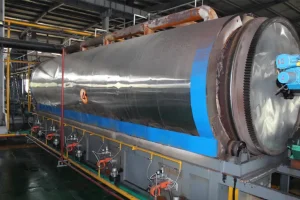
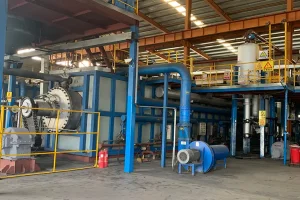
The core of our rubber recycling machines lies in our proprietary reactor design. Unlike standard factories, our reactors are built using boiler-quality carbon steel or stainless steel that can withstand extreme thermal cycling. The indirect heating method ensures that the tire material is decomposed in an oxygen-free environment, maximizing the quality of the oil and prevents combustion.
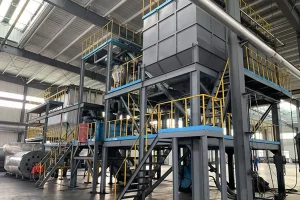
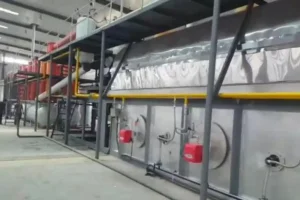
Our Continuous Pyrolysis Plant is specifically designed for 5-10cm tire blocks or rubber powder. It features a patented sealing system that allows for simultaneous feeding and discharging. This "non-stop" operation maintains a constant temperature within the reactor, saving up to 30% on fuel costs compared to batch reactors. Furthermore, our Carbon Black Refining Plants allow customers to upgrade raw carbon black into N330/N550 grade products, significantly increasing market value.
Environmental integrity is at our core. The non-condensable gas produced during the process is filtered and recycled back to the furnace to provide heat, making the system nearly self-sufficient. This level of technical maturity is why Huayuan Tech remains the preferred partner for global environmental infrastructure projects.
 Huayuan