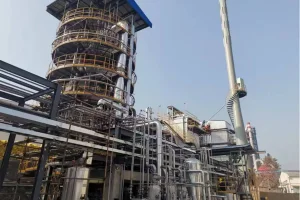
The global waste tire management landscape is undergoing a massive shift from traditional "disposal" to high-value "resource recovery." Often referred to as "Black Pollution," discarded tires represent one of the most challenging waste streams due to their durability and chemical complexity. However, with the rise of the Circular Economy, the tire recycling process has evolved into a multi-billion dollar industrial sector.
In regions like the European Union, North America, and Southeast Asia, stringent environmental regulations have phased out landfills for whole tires. This has created a massive surge in demand for Thermal Decomposition (Pyrolysis) technology. Unlike simple mechanical shredding, pyrolysis breaks down rubber into its original chemical components: Fuel Oil, Recovered Carbon Black (rCB), and Steel Wire. This process not only solves a waste problem but also provides sustainable raw materials for the manufacturing, construction, and energy sectors.
The global tire recycling market is projected to grow at a CAGR of over 4.5%. This is driven by ESG (Environmental, Social, and Governance) mandates and the rising cost of traditional crude oil products.
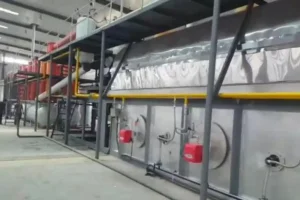
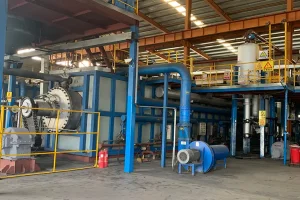
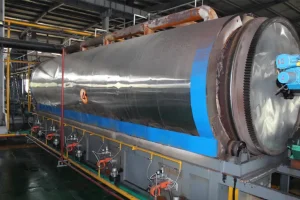
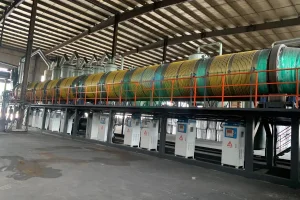
Transitioning from Batch Pyrolysis to Continuous Pyrolysis Systems has revolutionized efficiency, allowing for 24/7 operation with higher oil yields and lower emissions.
Global buyers now prioritize Safety, Environmental Compliance (EU Standards), and Automation. Automated feeding and discharging systems are now essential requirements.
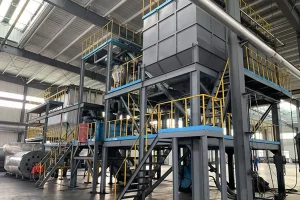
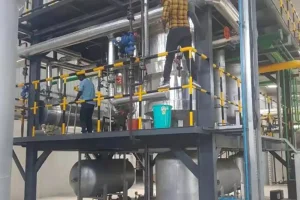
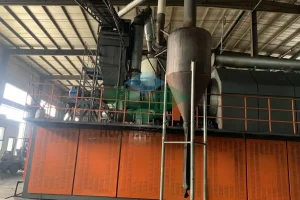
Founded in 1968, Huayuan Tech has been at the forefront of waste-to-energy and waste tire pyrolysis technology for over half a century. Our facility is not just a factory; it is a center for technical innovation in industrial recycling. With a total area of 209,335 square meters and a dedicated plant area of 98,680 square meters, we possess the scale and infrastructure to handle large-scale global orders.
Our commitment to quality is backed by a workforce of more than 500 employees, where 34% are engineering and technical professionals. This deep expertise ensures that every pyrolysis plant we manufacture meets the highest standards of safety and efficiency.
We hold a national A-class boiler and A2-class pressure vessel manufacturing license, alongside D1D2 pressure vessel design certificates. Our systems are certified under ISO9001, ISO14001, and OHSAS18001, and we are proud to carry the prestigious United States ASME certification. This makes us a trusted partner for international EPC projects and industrial thermal equipment integration.
A high-quality tire recycling process is defined by its ability to maximize output while minimizing environmental footprint. Here is how our industry-leading system operates:
Tires are shredded into rubber powder or 5-10cm blocks to increase surface area for heating.
In an oxygen-free reactor, rubber is heated to vaporize hydrocarbons without combustion.
Oil gas passes through heavy-duty condensers to liquefy into high-grade pyrolysis oil.
Non-condensable gases are scrubbed and recycled to fuel the reactor itself, saving energy.
Final collection of Fuel Oil, Carbon Black, and Steel Wire for commercial sale.
Our tire recycling plants are deployed across various localized industrial scenarios worldwide:
The ROI (Return on Investment) for a Huayuan Tech Continuous Pyrolysis Plant is typically achieved within 12 to 24 months, depending on local feedstock costs and output market prices.
We source high-grade raw materials locally, allowing us to offer competitive pricing without compromising on the quality of pressure vessels and thermal components.
Unlike standard off-the-shelf suppliers, our engineering team designs systems tailored to your specific feedstock (e.g., rubber powder, whole tires, or OTR tires).
We provide full-service support, from pressure pipe installation permits to on-site commissioning and global after-sales maintenance.
Focus on waste to energy and waste tire pyrolysis technology, Huayuan Tech was founded in 1968. Company covers an area of 209,335 square meters, plant area of 98,680 square meters, more than 500 employees, engineering and technical personnel accounting for 34% of the total number of employees. Has a complete A-class boilers and pressure vessels complete sets of manufacturing, testing equipment.
Pressure pipe installation permit, And through ISO9001, ISO14001, OHSAS18001 three system certification and the United States ASME certification.
With the continuous development of enterprises has now become engaged in a boiler, pressure vessels, waste tire and plastic scrap pyrolysis machine development, manufacturing, sales, consulting services, thermal equipment system integration, contract energy management, investment and financing, supplemented by energy efficient use of professional firms. Holding a national A-class boilers, A2-class pressure vessel manufacturing license, D1D2 pressure vessel design certificate.
 Huayuan